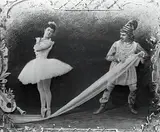
The NES Tetris uses Tchaikovsky's "Dance of the Sugar Plum Fairy" from The Nutcracker as its Music A.
Video Game· 1984· Puzzle
Tetris: it draws on 2 recorded sources.
The works this one is recorded as drawing on.
The NES Tetris uses Tchaikovsky's "Dance of the Sugar Plum Fairy" from The Nutcracker as its Music A.
Events, places, movements and ideas outside fiction that this work is recorded as drawing on.
Real world
Tetris is a maths puzzle turned into a game, and Alexey Pajitnov has said so. He was working at the Soviet Academy of Sciences Computer Centre and was interested in pentominoes, the twelve shapes made of five squares, which he had played with as a puzzle for years. He cut them down to four squares (seven shapes, hence the name, from the Greek for four) because five was too hard in real time, and added gravity and a deadline, which is the invention. The hardware shaped it as much as the maths. The Elektronika 60 had no graphics, so the first version drew its blocks out of text characters, and the shape of the well came from what a terminal could display.