Short StorySeries· 1894· Adventure

The Jungle Book

by Rudyard Kipling

The Jungle Book: 3 recorded works trace back to it, and it draws on 1 recorded source.

Open on the map

What The Jungle Book influenced

Works that record this one as a source, with the evidence a contributor gave.

The Jungle Book

Animation · 1967

AdaptationHIGH

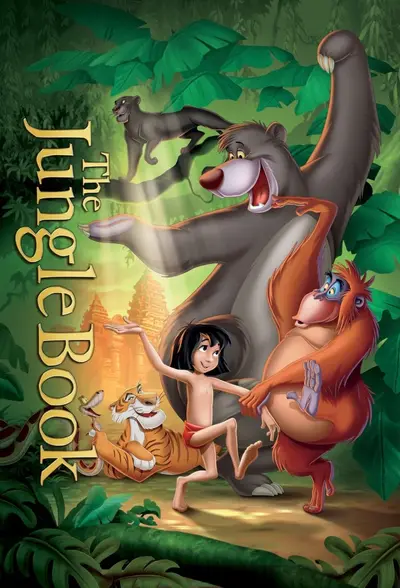
Disney's film takes its characters and setting from Kipling's 1894 collection: Mowgli raised by wolves, Bagheera, Baloo, Kaa, and Shere Khan as the tiger who wants him dead. The tone is the film's own and the distance is large. Kipling's stories are about law, hierarchy and belonging, and are written in a register closer to fable than to comedy; the film keeps the cast and the jungle and plays them as a musical. It is the version most audiences now mean by the title, which is itself part of the influence.
The Call of the Wild

Book · 1903

InfluenceMEDIUM

London read Kipling closely and defended him in print, and the shape is shared: an animal with a genuine interior life, a pack with laws that are stated and enforced, and a protagonist moving between the human world and the wild one. Kipling's Law of the Jungle becomes London's law of club and fang, which is the same device turned pessimistic. Mowgli's law is a civilising code; Buck's is what remains once the code is stripped away. MEDIUM because London wrote about Kipling's importance in general rather than naming The Jungle Book as a source for this book.

Tarzan

Book · 1912

InfluenceMEDIUM

Burroughs was writing eighteen years after Mowgli and the feral child was Kipling's invention as a popular form: a human infant orphaned in the wild, adopted by animals, taught their law, and then forced to choose between their world and his own. Tarzan keeps the structure and changes the politics, making his hero an English aristocrat whose breeding shows through the jungle. The debt is often noted and Burroughs acknowledged reading Kipling.

Real-world influences

Events, places, movements and ideas outside fiction that this work is recorded as drawing on.

Nature & Animals

Real world

Real-world influenceHIGH
  • Indian Jungle
  • Wolves
  • Seonee

Kipling names the place. The Mowgli stories are set in the Seoni hills of central India, and the animals in them are the animals of that forest: the Indian wolf, the sloth bear, the black panther, the dhole, the python, the tiger. The specifics come from natural history rather than from folklore. The Seeonee wolf pack, the Council Rock and the Law of the Jungle are built on wolf pack structure as it was then understood; the monkeys have no law because the book takes them to be a species without one; and the red dog chapter turns on dhole hunting behaviour. Behind it sits a documented phenomenon rather than a myth: Sir William Henry Sleeman's 1852 account of wolf-raised children in Seoni district, which Kipling had read.

About the work

The Jungle Book

This is a series.

The Jungle Books can be regarded as classic stories told by an adult to children. But they also constitute a complex literary work of art in which the whole of Kipling's philosophy of life is expressed in miniature. They are best known for the 'Mowgli' stories; the tale of a baby abandoned and brought up by wolves, educated in the ways and secrets of the jungle by Kaa the python, Baloo the bear, and Bagheera the black panther. The stories, a mixture of fantasy, myth, and magic, are underpinned by Kipling's abiding preoccupation with the theme of self-discovery, and the nature of the 'Law'.