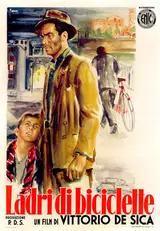
Haifaa al-Mansour has cited Bicycle Thieves among her inspirations: Wadjda's story turns, as De Sica's does, on a child's quest for a bicycle.
Film· 2012· Drama
by هيفاء المنصور Haifaa al-Mansour
وجدة (Wadjda): it draws on 2 recorded sources.
The works this one is recorded as drawing on.
Haifaa al-Mansour has cited Bicycle Thieves among her inspirations: Wadjda's story turns, as De Sica's does, on a child's quest for a bicycle.
Events, places, movements and ideas outside fiction that this work is recorded as drawing on.
Real world
Haifaa al-Mansour directed it from inside a van, because a woman could not stand in the street and direct men in Saudi Arabia in 2012. It was the first feature shot entirely in the country and the first by a Saudi woman. The film is about a girl who wants a bicycle and is told girls do not ride them, and everything around that is the system: the guardianship rules, a mother whose husband is taking a second wife because she cannot give him a son, a school principal enforcing rules she resents, and a Quran competition entered for prize money. The bicycle is not a symbol somebody chose. It was an actual prohibition, relaxed the year after the film was made.