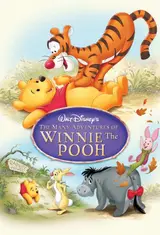
Disney's film gathers its Winnie the Pooh featurettes, adapted from A. A. Milne's books.
BookSeries· 1926· Children's
by A. A. Milne
Winnie-the-Pooh series: 1 recorded work traces back to it, and it draws on 2 recorded sources.
Works that record this one as a source, with the evidence a contributor gave.
Disney's film gathers its Winnie the Pooh featurettes, adapted from A. A. Milne's books.
Events, places, movements and ideas outside fiction that this work is recorded as drawing on.
Real world
The boy in the books is Milne's son, under his own name, and the animals are his toys. Christopher Robin Milne was given a bear from Harrods for his first birthday in 1921; Piglet, Eeyore, Kanga, Roo and Tigger were bought or given over the next few years, and all but Roo survive. The bear was renamed after Winnie, a black bear at London Zoo that the boy visited, and after a swan called Pooh. The stories began as things told to and about a real child in a real house, which is why they have the shape of a game rather than a plot. Christopher Milne spent much of his adult life writing about what it cost to be that child, which is part of the record too.
Real world
The Hundred Acre Wood is a real place and you can walk it. Ashdown Forest in East Sussex, beside Cotchford Farm, where A. A. Milne bought a house in 1925. The map at the front of the book is Ashdown: the Five Hundred Acre Wood is the real name of a part of it, Galleons Lap is Gills Lap, the Enchanted Place is a stand of pines at the top of it, and Poohsticks Bridge is a footbridge over a tributary of the Medway that people still play the game on. E. H. Shepard went and drew there, which is why the illustrations are recognisable landscape rather than generic woodland. The animals are Christopher Robin's toys and the country around them was not invented.