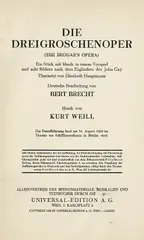
Brecht and Weill's Threepenny Opera is an adaptation of John Gay's ballad opera, keeping Macheath, Peachum and Polly.
Musical· 1728· Satire / Farce
by John Gay
The Beggar's Opera: 1 recorded work traces back to it.
Works that record this one as a source, with the evidence a contributor gave.
Brecht and Weill's Threepenny Opera is an adaptation of John Gay's ballad opera, keeping Macheath, Peachum and Polly.