James Mangold drew on Nolan's Dark Knight trilogy, admiring how it transcended spectacle by applying a specific film genre to superhero material.
FilmSeries· 2005· Superhero
The Dark Knight Trilogy: 4 recorded works trace back to it, and it draws on 11 recorded sources.
Works that record this one as a source, with the evidence a contributor gave.
James Mangold drew on Nolan's Dark Knight trilogy, admiring how it transcended spectacle by applying a specific film genre to superhero material.
Favreau compared his approach to Batman Begins: a grounded, realistic superhero origin, with an independent-film sensibility.
Leigh Whannell surveyed werewolf designs from The Wolf Man (1941) to Dog Soldiers, and said he was inspired by Heath Ledger's take on the Joker in The Dark Knight.
Michael B. Jordan told Empire he studied Heath Ledger's Joker in The Dark Knight, with Fassbender's Magneto, to build Killmonger.
The works this one is recorded as drawing on.
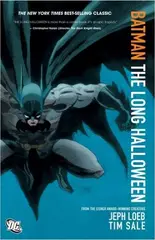
Nolan and David S. Goyer have named Loeb and Sale's The Long Halloween as a source for The Dark Knight: Batman, Gordon and Harvey Dent working together against the mob, and Dent's fall into Two-Face as the cost of that alliance.
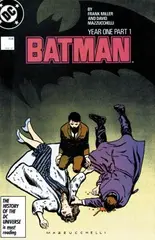
Batman Begins builds on Frank Miller and David Mazzucchelli's Year One: Bruce Wayne's return to a corrupt Gotham, Jim Gordon as an honest officer in a crooked department, and Falcone as the city's crime boss.
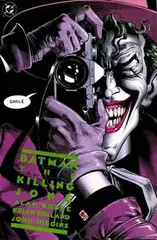
Christopher Nolan said in 2006 that Alan Moore's The Killing Joke was a major influence on how he would portray the Joker in The Dark Knight, and co-writer David S. Goyer named it among his key sources.
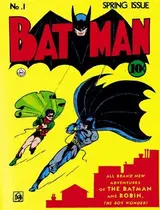
Christopher Nolan's trilogy, Batman Begins (2005), The Dark Knight (2008) and The Dark Knight Rises (2012), adapts DC's Batman comics.
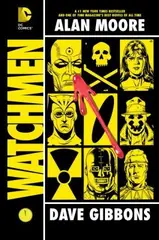
Nolan's trilogy is the first mainstream superhero cinema built on the premises Watchmen put into comics twenty years earlier: that a costumed vigilante is a political fact with consequences, that a city would react to him, and that the villain may be the one arguing coherently. The Dark Knight's ending is the Watchmen ending. A mass deception is chosen over the truth because the truth would undo the peace, and the film leaves the audience to decide whether that was right. Ozymandias and Gordon make the same bargain. Filed MEDIUM, and the limit stated: Nolan has cited Year One and The Long Halloween rather than Watchmen.
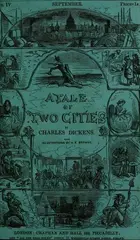
Christopher and Jonathan Nolan have named A Tale of Two Cities as the model for The Dark Knight Rises, and the film quotes it at the end: Gordon reads Sydney Carton's closing lines, "It is a far, far better thing that I do", at Bruce Wayne's funeral.
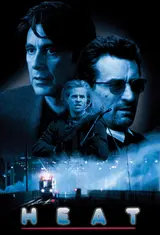
Christopher Nolan has named Michael Mann's Heat as a model for The Dark Knight: a crime epic about a city, with a daylight bank robbery staged with a crew in masks, and a relationship between hunter and hunted at its centre. The Dark Knight's opening heist is the clearest instance.
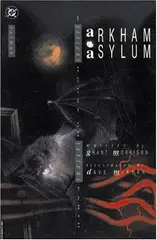
Heath Ledger cited Arkham Asylum as an inspiration while preparing his Joker for The Dark Knight, and the film's viral campaign drew on it with The Killing Joke and The Long Halloween.
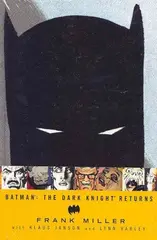
Co-writer David S. Goyer named Frank Miller's The Dark Knight Returns, with The Long Halloween and The Killing Joke, as the comics his research for the Nolan films was built on.
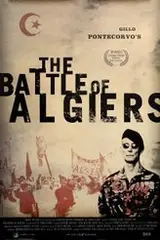
Christopher Nolan names The Battle of Algiers among his favourite films and credits it as an influence on The Dark Knight Rises.
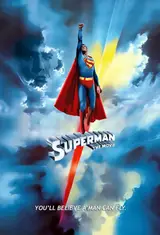
Christopher Nolan cited the vision and scope of Richard Donner's Superman when he pitched Batman Begins to Warner Bros.