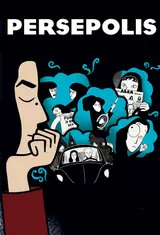
Marjane Satrapi co-directed the film of her own graphic memoir with Vincent Paronnaud, keeping the book's stark black and white drawing and its story of a girlhood in revolutionary Iran and exile in Europe.
Comic· 2000· Nonfiction
Persepolis: 2 recorded works trace back to it, and it draws on 4 recorded sources.
Works that record this one as a source, with the evidence a contributor gave.
Marjane Satrapi co-directed the film of her own graphic memoir with Vincent Paronnaud, keeping the book's stark black and white drawing and its story of a girlhood in revolutionary Iran and exile in Europe.
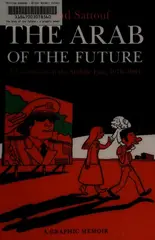
Riad Sattouf, who knew Marjane Satrapi through L'Association, has said that when Persepolis came out he thought he would have to wait fifteen years to make his own. L'Arabe du futur opens the same way, a child introducing himself at the start of the 1980s, and tells a Middle Eastern childhood in black and white panels.
The works this one is recorded as drawing on.

Marjane Satrapi has said that reading Art Spiegelman's Maus showed her a comic could tell a family's history and a political catastrophe, and led her to tell her own story the same way, in stark black and white.

Satrapi has credited David B., her friend and fellow member of L'Association, with showing her the form: his autobiographical Epileptic, drawn in heavy black and white with symbolic imagery, is the model for the look of Persepolis.
Events, places, movements and ideas outside fiction that this work is recorded as drawing on.
Real world
The memoir is a child's view of the 1979 revolution, the Islamic Republic that followed and the war between Iran and Iraq, seen through a family of left-wing opponents of both the Shah and the regime.
Real world
Marjane Satrapi's autobiography of growing up in Tehran during the revolution and the war with Iraq, and of being sent alone to school in Vienna at fourteen.